America’s Commercialization Gap Is a Geography Problem
And that's why we’re building Inventrix - to help fix it.
The United States leads the world in publicly funded research.
But when it comes to commercialization, venture deployment, and translation into real-world impact, the system is profoundly uneven.
Why this matters
Venture capital does not just follow ideas. It follows visibility, proximity, and established intermediaries.
A small number of states and regions dominate outcomes.
Most of the country — including many research-producing states — is left behind.
This isn’t anecdotal. The data is unambiguous.
Key takeaways
-
U.S. innovation is national; commercialization is not.
Research is produced across the country, but venture capital and scale-stage outcomes are concentrated in a small number of states. -
Geography, not merit, often determines which ideas reach the market.
Visibility and timing — not idea quality — drive capital flow. -
South Dakota is representative, not exceptional.
Low R&D intensity and minimal venture deployment reflect a broader structural gap faced by many interior states. -
The problem is structural, not cultural.
Discovery is locked behind institutions, commercialization starts too late, and tech transfer operates at human scale. -
Earlier, public-first discovery is the leverage point.
Translational signals must be visible before patents, startups, and geography decide outcomes. -
Inventrix is built as infrastructure, not a dashboard.
Its role is to surface early signals and enable discovery-driven dealflow across institutions and states.
The national reality: capital and commercialization are highly concentrated
Across the U.S.:
- A handful of states (California, Massachusetts, New York, Texas) capture a disproportionate share of venture capital and scale-stage outcomes.
- Much of the interior of the country captures a rounding error in deployed venture dollars.
- Research happens everywhere — translation does not.
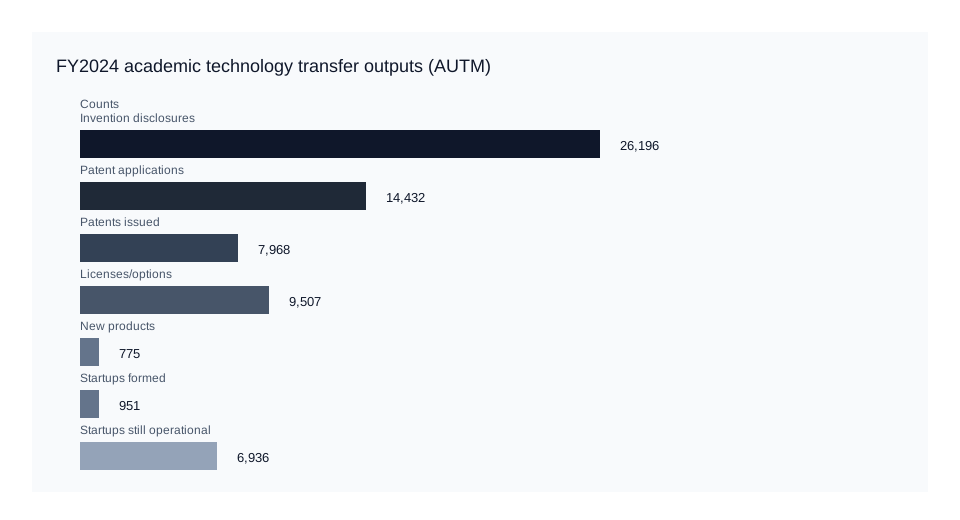
The FY2024 counts above reflect disclosure, patenting, licensing, and startup activity tracked in the AUTM 2024 infographic.1
This concentration compounds over time:
- Capital follows visibility
- Visibility follows prior exits
- Everyone else remains invisible — regardless of research quality
The result is a self-reinforcing loop where geography, not merit, determines which ideas make it to market.
Geography, not merit, often determines which ideas reach the market.
South Dakota: a data-backed case study in the gap
South Dakota is not an outlier.
It is representative.
According to the South Dakota Science & Technology Plan 2030 (RTI, 2025), the state sits near the bottom nationally on several indicators strongly correlated with commercialization success:
R&D intensity
- South Dakota: 0.55% of GDP
- United States: 3.33% of GDP
That’s roughly a 6× gap in research intensity.
National rankings
- Business R&D: 47th
- Academic R&D: 50th
Venture capital deployment (2019–2023)
- Total VC deals: ~38
- Total VC investment: ~$57M over five years
For context:
A single venture deal in a leading hub can exceed this entire five-year total.
Even under optimistic projections in the plan’s impact scenarios, South Dakota remains far behind national innovation leaders through the 2030s.
This is not a South Dakota problem.
It is a systemic U.S. discovery and translation problem.
What’s actually broken nationwide
The issue is not talent.
It’s not ideas.
And it’s not a lack of federal research funding.
The failures are structural.
1) Discovery is locked behind institutions
- Research signals are buried in PDFs, portals, and internal systems.
- Publicly funded work is often not publicly discoverable in a way that investors, industry, and policymakers can use.
- As a result, opportunity is seen too late — or not at all.
2) Commercialization starts too late
In many settings, meaningful commercialization engagement happens only:
- after invention disclosure
- after patents
- after momentum is lost
By then, the window for decisive early pull (industry interest, validation partners, early capital) has often closed.
3) Tech transfer is manual and local
Most tech transfer workflows operate at human scale:
- manual triage
- fragmented market intelligence
- limited cross-institutional visibility
The system is not designed for modern pattern detection across the national research landscape.
The consequence is predictable:
capital flows to familiarity, not necessarily to merit.
What needs to change
If the U.S. wants innovation everywhere — not just on the coasts — three shifts are required:
-
Earlier discovery of translational signals
Before patents. Before startups. Before geography decides outcomes. -
Public-first research intelligence
Taxpayer-funded research should be visible by default — not fragmented across opaque systems. -
Cross-institutional pattern detection
Innovation does not respect university or state boundaries — our discovery systems should reflect that reality.
What Inventrix changes
Inventrix is infrastructure for national discovery.
Not another portal. Not a vanity dashboard.
A system built to make the early signals of translation visible and usable.
Inventrix is designed to:
- Surface where research is moving, not just where it has been
- Make early translational signals visible
- Connect scholars, inventions, startups, and emerging domains across institutions and states
- Enable capital, industry, and policymakers to see opportunity earlier — and more broadly
In short:
Inventrix turns discovery into dealflow — regardless of geography.
Why this matters now
Federal agencies are demanding clearer translational pathways.
States are investing in commercialization strategies.
Universities are under pressure to demonstrate real-world impact.
But without public, intelligent discovery, capital will continue to cluster — and most regions will continue to underperform.
Inventrix exists to change that trajectory.
Closing
Innovation should not depend on ZIP code.
Commercialization should not depend on proximity.
Discovery should not be hidden.
We’re building Inventrix in public — because the future of research translation must be public too.
Appendix: what “public-first discovery” means in practice
Public-first discovery is not “open access” as a slogan. It’s operational:
- Public indexing of research directions and emerging topic clusters
- Entity-level linking between people, labs, grants, publications, and downstream adoption signals
- Early-signal detection (new collaborations, fast-rising topics, cross-domain convergence)
- Actionable paths for industry and capital to engage early and responsibly
The goal is not to replace tech transfer offices.
The goal is to give every institution — especially those outside major hubs — the discovery infrastructure needed to compete on merit.
Footnotes
-
AUTM, "U.S. Academic Technology Transfer for 2024" infographic (FY2024). ↩